
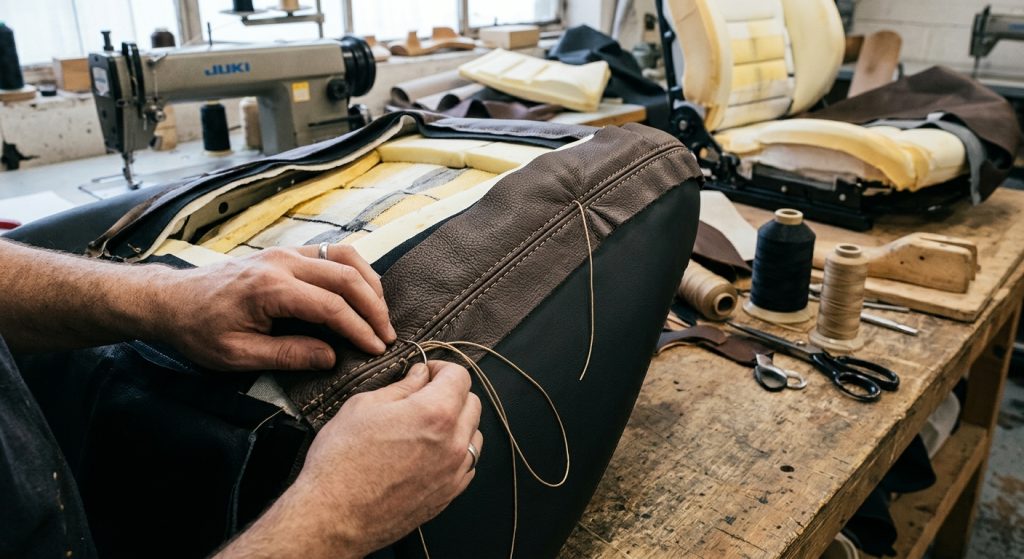
Bolstered seats combine a supportive center panel with raised side contours, so their comfort depends on more than cushion softness. Matching foam density, foam firmness, seam construction, and upholstery materials helps the bolsters retain their shape while resisting wear from repeated entry, exit, and driving.
Foam Density for Bolstered Seat Support
Foam density measures material mass per cubic foot, while indentation load deflection, or ILD, indicates firmness. These properties work independently: dense foam can feel soft, and lower-density foam can feel firm initially but lose support sooner.
For frequently used seat bases, consider high-resilience foam around 2.0–2.5 pounds per cubic foot. A typical firmness range of 35–45 ILD supports the occupant, although body shape, seat depth, and vehicle use can change the preferred specification.
Bolsters face concentrated pressure as occupants slide across them. Use foam with sufficient resilience to recover its profile, and avoid relying on firmness alone to prevent collapse. A very firm, low-density insert may feel supportive at first but fatigue prematurely.
Foam Thickness and Bolster Shape
Foam thickness influences how deeply an occupant settles into the seat and how effectively the side supports maintain their shape. A thicker insert may improve cushioning, but excessive thickness can reduce usable seating width or make the bolsters feel restrictive. The correct profile should follow the original seat geometry and provide support without creating pressure points.
For side bolsters, firmer foam or a layered construction can help maintain the raised contours. A softer upper layer may improve comfort, while a more resilient base layer provides structural support. Transitions between these layers should be smooth to prevent noticeable ridges beneath the upholstery.
Upholstery Materials and Seam Durability
The outer material must withstand friction, stretching and repeated contact. Automotive leather, durable vinyl and abrasion-resistant automotive fabrics each offer different advantages. Leather provides a premium finish, while quality vinyl can simplify cleaning. Fabric may offer breathability, depending on its weave and backing.
Seam placement is equally important. Positioning seams away from the highest-pressure contact areas can reduce stress on the stitching. Reinforced seams and suitable upholstery thread help prevent premature separation, particularly where the material stretches tightly over curved bolster sections.
|
Component |
Recommended consideration |
Main benefit |
|---|---|---|
|
Seat-base foam |
High-resilience foam, around 2.0–2.5 lb/ft³ |
Helps maintain cushioning over time |
|
Foam firmness |
Approximately 35–45 ILD as a starting point |
Balances support and comfort |
|
Side bolsters |
Shaped, resilient foam |
Preserves contour and lateral support |
|
Upholstery |
Automotive-grade leather, vinyl or fabric |
Resists everyday wear |
|
Stitching |
Reinforced seams and suitable thread |
Reduces the risk of seam failure |
These figures are general starting points rather than universal specifications. The appropriate foam and upholstery depend on the seat design, manufacturer requirements and intended use.
Installation and Long-Term Performance
Even well-selected materials can perform poorly if installed incorrectly. Foam should fit the seat frame without gaps, excessive compression or uneven transitions. Upholstery tension must be sufficient to maintain a smooth finish without overstressing seams or distorting the bolster profile.
After installation, check that the seat feels comfortable in different driving positions and that the side supports do not restrict movement. Inspect high-contact areas periodically for flattened foam, loose stitching or surface cracking.
Ultimately, durable bolstered seats require a balance between foam density, firmness, thickness and upholstery construction. Choosing compatible materials and fitting them carefully helps preserve comfort, support and appearance through repeated daily use.


