
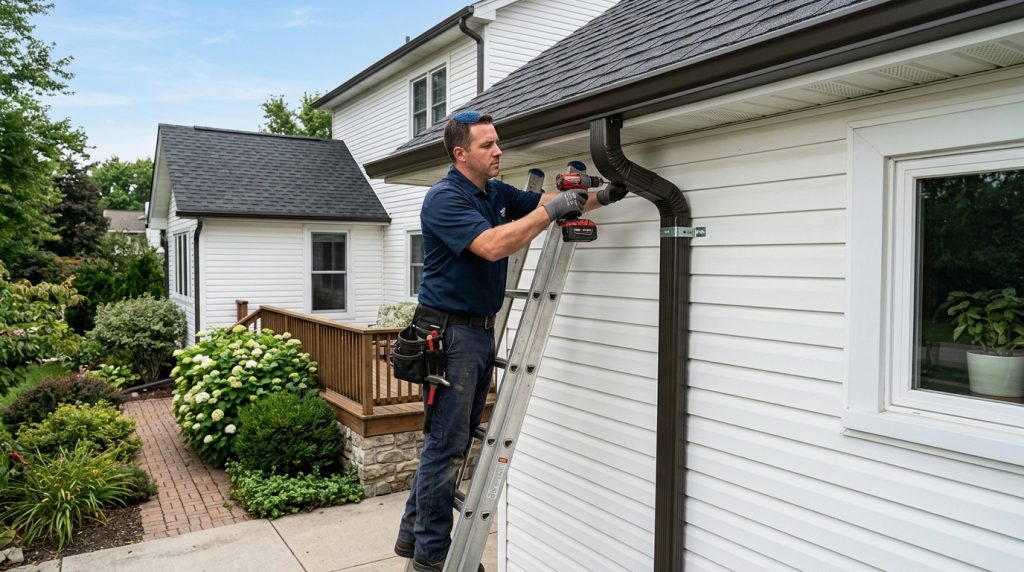
Roof runoff can quietly undermine a home when it falls beside the walls instead of flowing safely away. Proper downspout installation connects gutter systems to a dependable route for rainwater drainage, helping limit soil saturation, foundation erosion and the conditions that can lead to basement leaks.
Effective foundation protection depends on more than adding a pipe to a gutter: placement, capacity, discharge location and ongoing care all influence how well water is diverted. Understanding these details makes water damage prevention more reliable and helps residential drainage work with the property’s grading, soil and local conditions.

Directing Roof Runoff Away from the Foundation
A roof gathers a large volume of rain across a broad surface, then concentrates it at the gutter outlets. Without effective downspouts, that water can spill beside the house, repeatedly soaking the same strip of soil and increasing the risk of movement or deterioration near the foundation.
Downspouts create a controlled path from the roof edge to a safer discharge point. This simple form of water diversion supports rainwater drainage and reduces the chance that runoff will pool against exterior walls or enter through vulnerable openings.
Reducing Soil Saturation and Foundation Erosion
Soil that stays wet for extended periods may expand, soften or lose stability, depending on its composition and local conditions. Repeated runoff can also wash away surface soil, gradually exposing landscaping or contributing to foundation erosion around the perimeter.
A downspout should therefore release water far enough from the building to avoid immediate reabsorption beside the foundation. The appropriate discharge point depends on the slope, soil, climate and drainage layout; directing water onto a neighbouring property or toward a walkway can simply transfer the problem.
Limiting Basement Leaks and Moisture Intrusion
Water collecting around foundation walls can find its way through cracks, joints or other weak points, particularly where drainage is already poor. A well-planned system does not guarantee a dry basement, but it reduces one common source of pressure and helps prevent avoidable basement leaks.
Downspouts work best as part of a broader drainage plan. Guidance on practical home drainage improvements can complement an assessment of gutter outlets, ground slope and existing water pathways.
Choosing Downspout Installation Details That Work
Once the runoff route is understood, the system needs to be sized and positioned to handle the water collected by the roof. A downspout that is undersized, poorly connected or blocked may overflow during heavy rain, even when the rest of the gutter systems appear to be in good condition.
Before installation, inspect the roof area, gutter outlets and ground around the home. The following choices help align downspout installation with the property’s drainage needs:
- Match capacity to the roof and rainfall. Large roof sections or intense local storms may require more drainage capacity or additional outlets.
- Secure every connection. Tight joints and stable fastenings help prevent leaks and keep water moving through the intended route.
- Plan a suitable discharge point. Use an extension or an appropriate drainage feature to carry water away without creating a hazard or directing it toward another structure.
- Check the surrounding grade. Ground that slopes toward the house can send discharged water back to the foundation, undermining the intended protection.
Where an underground drain is considered, its route and outlet need careful planning so water does not become trapped or emerge beside the building. Related advice on maintaining exterior drainage can help homeowners understand how outdoor water management fits into a broader property care routine.
Comparing Common Discharge Options
Different sites call for different solutions: a surface extension may suit an open, gently sloped yard, while a properly designed drain can help manage runoff where space is limited. The table below summarizes the purpose of common approaches, though local requirements and site conditions should guide the final choice.
| Discharge option | Typical purpose | Key consideration |
|---|---|---|
| Downspout extension | Moves water farther from the wall | Keep the outlet stable and clear of paths |
| Splash block | Disperses water at the outlet | Place it on a stable surface that directs flow away |
| Underground drain | Conveys runoff through a buried route | Provide a suitable outlet and prevent blockage |
Maintaining Reliable Residential Drainage
Even a correctly installed system can lose effectiveness when leaves, roof granules or debris obstruct its flow. Seasonal inspection helps reveal loose fittings, cracks, corrosion, disconnected extensions and signs that water is pooling close to the home.
Maintenance also makes it easier to spot changes in the drainage pattern after landscaping, paving or construction work. These alterations can redirect runoff, so a system that once protected the foundation may need adjustment as the property evolves.
Inspecting Gutters, Outlets and Ground Conditions
During routine checks, confirm that gutters carry water toward their outlets and that downspouts discharge freely. Look for soil washed away below an outlet, persistent dampness near the wall, staining on the foundation or water gathering after rainfall; each may indicate that the current route needs attention.
Keep the surrounding area clear enough for water to flow, and avoid burying a downspout outlet without a designed connection. For additional perspectives on outdoor upkeep, home exterior maintenance guidance and advice on managing water around the property can provide useful context.
Coordinating Downspouts with the Whole Drainage Plan
Downspouts are one component of residential drainage, not a substitute for sound grading, functioning perimeter drains or repairs to damaged foundation materials. Persistent dampness, recurring leaks or visible movement warrants a professional assessment, since the cause may extend beyond roof runoff.
When the roof, gutters, downspouts and ground slope work in concert, water has a clear route away from the home. That coordinated approach is the lasting value of proper installation: less uncontrolled runoff at the foundation and a more dependable defence against water damage.


