

An injector balance test shows how an engine control unit adjusts fuel delivery to keep cylinder output even. On common-rail diesel engines, the ECU tracks crankshaft speed changes during each cylinder’s firing window. It then changes individual fuelling commands to compensate for uneven torque.
Correction Patterns and Engine Behaviour
A healthy engine usually shows modest values near the neutral point, although normal readings depend on its design. Temperature, load, idle speed, and fuel pressure can shift the figures. A warm-idle snapshot therefore provides only one view of the system.
Compare cylinders under repeatable conditions and note whether one value stands apart. A growing deviation across several checks may reveal a developing fault more clearly than a single reading. When the scan tool supports data logging, recorded trends can show whether an imbalance worsens over time.
Corrections can also hide symptoms. The ECU may keep an engine running smoothly by compensating for a weak cylinder. A smooth idle does not prove that every injector works correctly, and a rough idle does not prove that an injector failed.
Balance readings also differ from a direct measurement of injector flow rate. The ECU estimates cylinder contribution from engine behaviour; it does not measure the exact amount of fuel leaving each nozzle. A bench test measures delivery across defined operating conditions and offers stronger evidence about injector performance.
What correction values can reveal
The direction and size of a correction can provide useful clues when interpreted alongside other engine data. A cylinder receiving a positive correction may be contributing less torque than expected, prompting the ECU to increase its commanded fuel. A negative correction may indicate that the ECU is reducing fuel because that cylinder appears to produce more torque than the others.
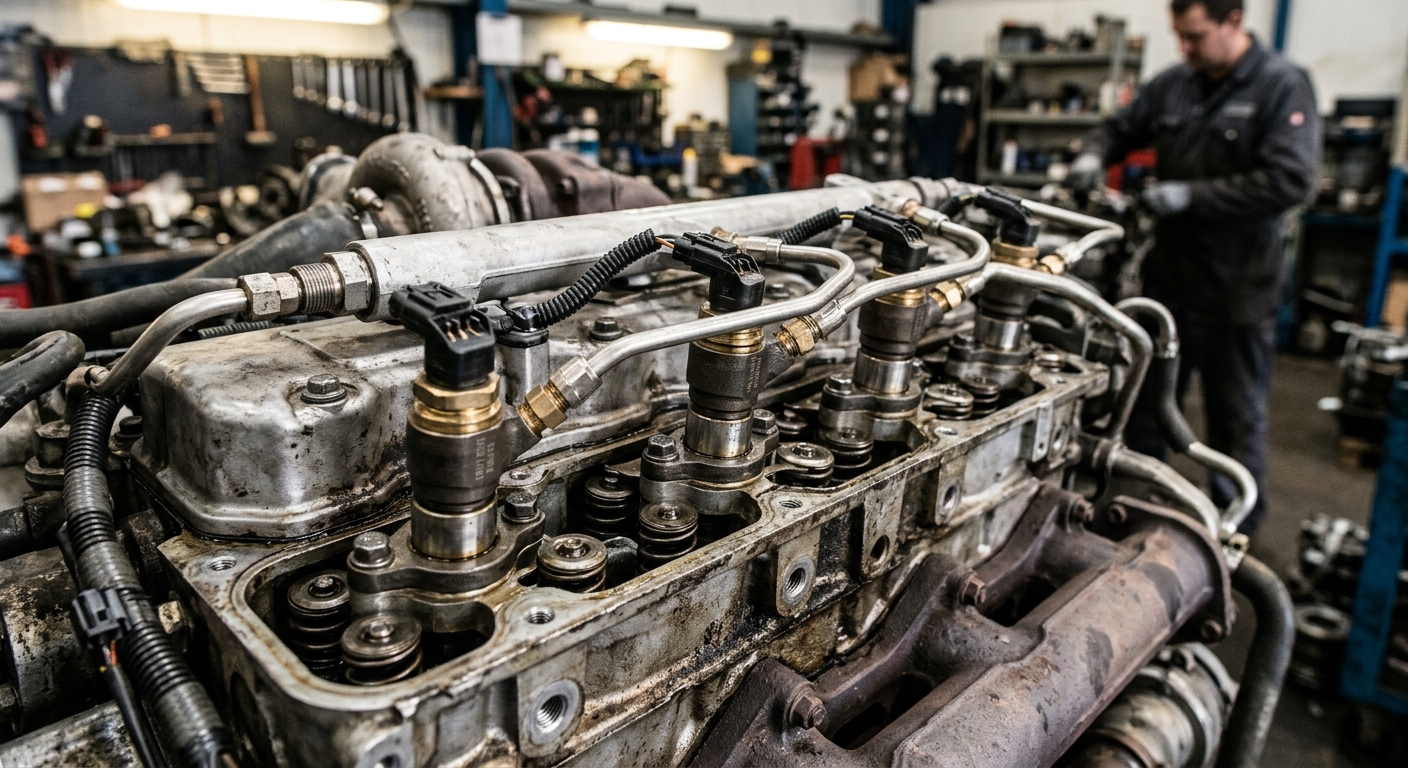
However, these values should not be treated as a direct diagnosis. A cylinder showing an unusual correction can be affected by several other factors, including compression, valve condition, combustion quality, fuel pressure or wiring. An injector may therefore appear to be the problem when the underlying fault lies elsewhere.
Testing before replacing injectors
An injector balance test is most useful as part of a wider diagnostic process. If one cylinder consistently shows an abnormal correction, inspect the relevant injector circuit, check for stored fault codes and compare the result with other available data. Depending on the engine, a technician may also perform a leak-off test, compression test or fuel-pressure check.
| Diagnostic check | What it indicates | Limitation |
|---|---|---|
| Injector balance test | How the ECU is compensating for differences in cylinder contribution | Does not directly measure injector flow |
| Leak-off test | Amount of fuel returning through each injector | Does not assess every aspect of injector operation |
| Compression test | Mechanical condition of the cylinders | Requires interpretation alongside other engine data |
| Fuel-pressure test | Whether the fuel system maintains the required pressure | A pressure fault may affect multiple cylinders |
| Injector bench test | Actual injector performance under controlled conditions | Usually requires injector removal |
A leak-off test can be particularly useful on common-rail systems because excessive return flow may indicate internal injector wear. Comparing the quantity returned by each injector helps identify units that behave differently from the others. This does not replace a bench test, but it can provide valuable evidence before removing the injectors.
 Using balance data for diagnosis
The most reliable interpretation comes from looking for patterns rather than focusing on one number. Record the readings with the engine at the specified operating temperature and repeat the test under the same conditions. If one cylinder remains significantly different while the others stay relatively consistent, further investigation is justified.
It is also useful to compare balance corrections with symptoms such as difficult starting, uneven idle, excessive smoke, poor acceleration or unusual combustion noise. When several signs point toward the same cylinder, the balance data becomes more meaningful.
An injector balance test is therefore a diagnostic aid rather than a pass-or-fail measurement. It shows how the ECU is responding to differences in cylinder contribution, but it cannot independently confirm injector condition. Combining correction values with fuel-system tests, mechanical checks and observed engine symptoms provides a much stronger basis for deciding whether an injector needs cleaning, testing, repair or replacement.


